Matching and sorting games are excellent tools to help your child develop early logic skills. These activities encourage them to recognize patterns, group objects by similarities like color and shape, and understand how to organize information systematically. They also boost fine motor skills and attention to detail. By engaging in these playful tasks, your child builds a strong foundation for problem-solving and cognitive growth. Keep exploring to discover more ways these games can support your child’s development.
Key Takeaways
- Matching and sorting games develop critical early logic skills and foundational understanding of classification and organization.
- They enhance color recognition and attention to visual details through categorization activities.
- These games support pattern recognition, teaching sequences, and structure recognition for cognitive growth.
- They improve fine motor skills and hand-eye coordination through precise object manipulation.
- Sorting activities foster organization skills applicable to daily routines and systematic thinking.
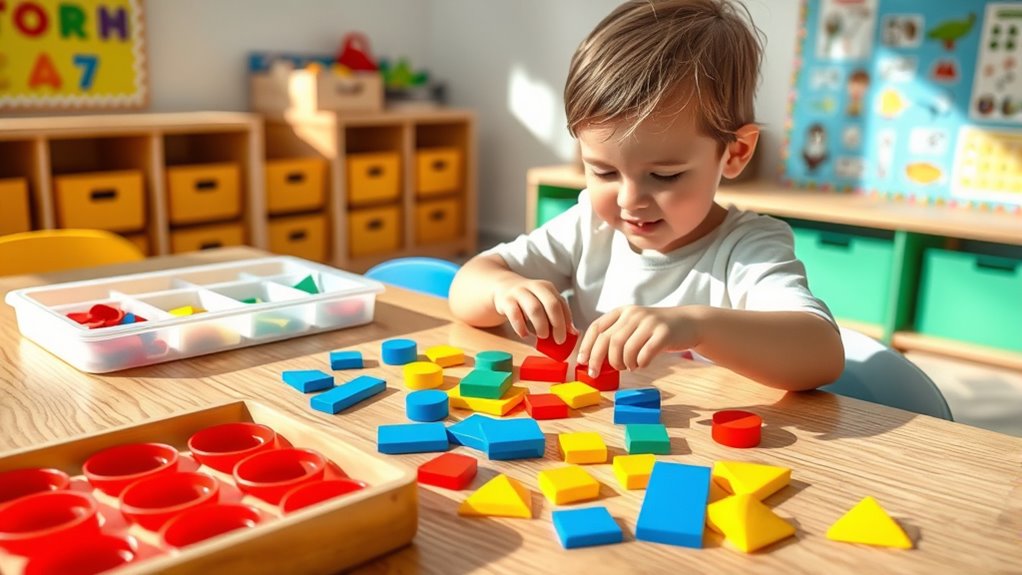
Matching and sorting games are excellent tools for developing early logic skills in young children. These activities serve as foundational exercises that help children understand how to classify and organize objects, which are essential skills for problem-solving and cognitive growth. When you introduce matching and sorting activities, you’re guiding your child to recognize similarities and differences among objects, laying the groundwork for more complex reasoning tasks later on. These games also promote active engagement, making learning both fun and meaningful.
One of the key benefits of these games is how they boost color recognition. As your child sorts objects by color, they become more aware of hues, shades, and the concept of categorization based on visual features. For example, you might encourage them to sort colored blocks into piles of red, blue, and yellow. This process not only helps them identify colors more accurately but also strengthens their attention to detail. Over time, they’ll begin to notice subtle differences in shades and understand that colors can be grouped in various ways, enhancing their overall visual discrimination skills.
Boost your child’s color recognition by sorting objects; it enhances attention to detail and visual discrimination skills.
Pattern development is another essential aspect that these games support. When children match objects based on patterns—such as stripes, polka dots, or solid colors—they learn to recognize sequences and repetitions. This practice develops their ability to see order and structure in their environment, which is vital for mathematical reasoning and logical thinking. For instance, arranging beads in a repeating color sequence or matching shapes that follow a specific pattern helps your child grasp the concept of order and predictability. These skills are fundamental for understanding more complex patterns encountered in math, science, and daily life.
Furthermore, engaging in matching and sorting games encourages your child’s fine motor skills and hand-eye coordination. Picking up small objects, aligning them correctly, and placing them into appropriate groups require precision and control. These physical aspects complement the cognitive benefits, fostering a well-rounded development. As your child becomes more proficient at these tasks, you’ll notice increased confidence and independence in their problem-solving abilities.
In addition to the cognitive and motor benefits, these games nurture your child’s sense of organization and classification. By categorizing objects based on color, shape, or pattern, they learn to create order out of chaos, a skill that extends beyond play into everyday routines. Whether sorting laundry by color or organizing toys, these early experiences build habits of structured thinking.
Conclusion
By exploring matching and sorting games, you plant the seeds for your child’s growing logical mind. These activities are like gentle waves shaping a sturdy shore, building confidence and critical thinking muscles. When you encourage these skills early on, you’re laying a foundation as strong as a fortress, ready to support future learning adventures. So, embrace these games—they’re the keys revealing your child’s potential, turning tiny sparks into a blazing fire of curiosity and skill.