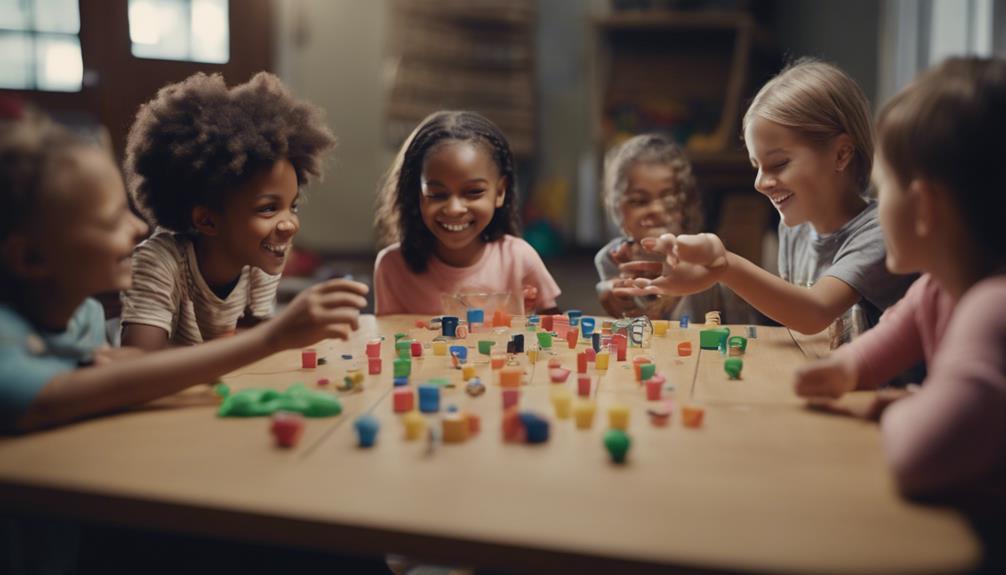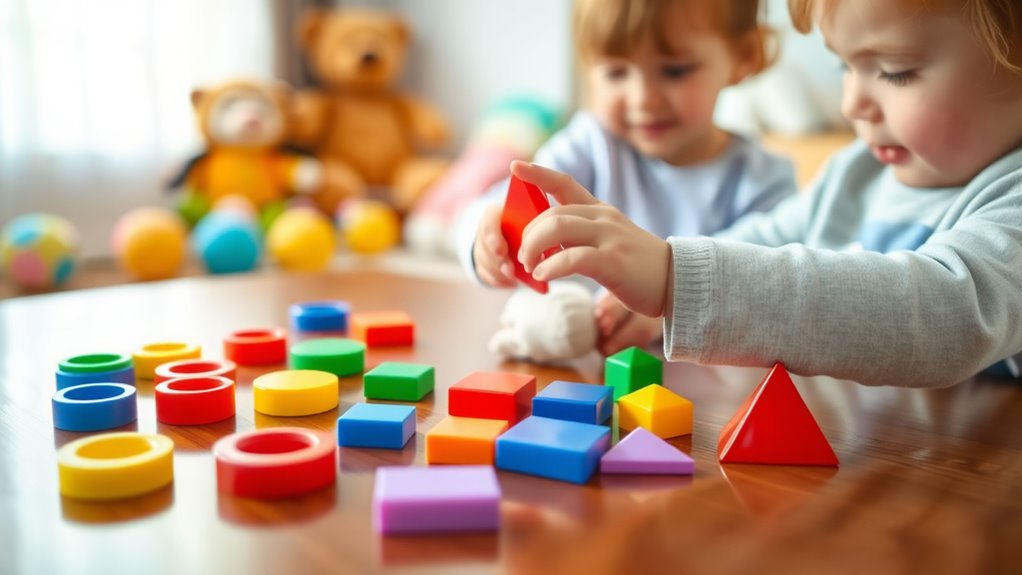

Sorting and matching games for toddlers are excellent ways to boost their cognitive, motor, and visual skills while keeping them engaged. You can use colorful blocks, picture cards, or household items to help your child practice sorting by color, shape, or category. These activities also improve hand-eye coordination and focus. As your child gains confidence, you can introduce more challenging tasks. Keep exploring, and you’ll discover even more fun ideas to support their development!
Key Takeaways
- Sorting activities with colored blocks, shapes, or household items enhance cognitive and fine motor skills in toddlers.
- Matching games like picture cards or socks develop visual discrimination and memory.
- Using themed sets or real-world objects makes activities more engaging and relatable for toddlers.
- Progression includes increasing complexity, such as sorting by multiple attributes or detailed images.
- Consistent encouragement and routine integration foster confidence, love for learning, and skill development.

Sorting and matching games are fantastic ways to boost your toddler’s cognitive development while keeping them engaged and entertained. These activities help your little one learn essential skills like color recognition and improve their fine motor skills, which are indispensable at this stage of growth. When you introduce simple sorting games, such as separating colored blocks or sorting shapes into matching containers, you’re providing opportunities for your toddler to explore and understand the concept of categories. As they pick up objects and decide where they belong, they’re practicing their ability to distinguish different colors, which lays a foundation for more advanced color recognition. This process also encourages hand-eye coordination, as they grasp small items and place them in the correct spots, sharpening their fine motor skills.
Sorting and matching games enhance cognitive skills and fine motor development through fun, category exploration and color recognition practice.
Matching games, like pairing socks or matching picture cards, are equally effective. They challenge your toddler to recognize similarities and differences, reinforcing their understanding of colors, shapes, and objects. When your child finds matching pairs, they’re not only developing their visual discrimination but also honing their concentration and memory. These skills are indispensable for later academic tasks, such as reading and writing. Plus, as they manipulate pieces—be it flipping cards or fitting shapes into corresponding slots—they’re strengthening their hand muscles and improving their dexterity, which is essential for writing and other precise movements. Incorporating activities that promote visual discrimination can further enhance these skills and support their overall development.
You can make these activities more engaging by using everyday items or creating themed sets. For example, gather different colored buttons, pasta, or small toys, and encourage your toddler to sort them by color. This not only makes the activity more fun but also helps them connect colors to real-world objects. When matching, you might use household items like matching different colored lids to their containers or pairing up animal figures by color. These simple tasks reinforce their understanding of colors and give them a sense of accomplishment as they successfully complete each task.
The key is to keep the activities age-appropriate, short, and varied to maintain your toddler’s interest. As they become more confident, you can introduce more complex sorting and matching challenges, like sorting by multiple attributes or matching more detailed pictures. Remember, your encouragement and praise play a huge role in building their confidence and love for learning. By regularly incorporating sorting and matching games into your routine, you’re helping your toddler develop critical cognitive and fine motor skills that will serve as a strong foundation for their future learning adventures.
Conclusion
As you introduce sorting and matching games, you’re planting seeds of curiosity and confidence in your toddler’s heart. Watching them explore, connect, and succeed is like witnessing a sunrise—bright, inspiring, full of promise. These simple activities are the keys to opening a world of learning and joy. Keep nurturing that spark, and you’ll see your little one blossom into a curious explorer, ready to paint their world with the vibrant colors of discovery and growth.