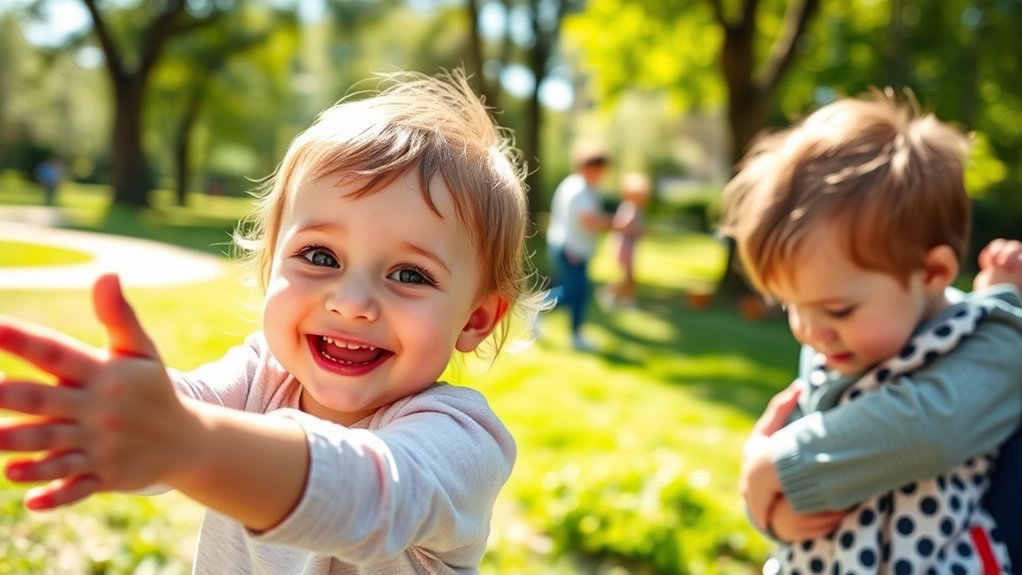

Understanding your child’s social milestones like smiling, stranger anxiety, and play behaviors helps you gauge their emotional growth. A smile signifies early social connection and comfort, while stranger anxiety shows healthy caution and developing trust. Playdates teach sharing, taking turns, and confidence. As your child experiences these milestones, they build important skills for future friendships and social settings. Continuing this journey will reveal even more about their evolving social competence.

Turn the school run and nap time into listening time
- Thousands of audiobooks, podcasts and originals
- Listen on your phone, tablet or Echo — also offline
- Cancel anytime
Key Takeaways
- Smiling is an early social milestone indicating recognition, comfort, and emerging nonverbal communication skills.
- Playdates help children develop sharing, cooperation, and social boundaries, fostering confidence and social competence.
- Stranger anxiety is a normal developmental phase showing differentiation between familiar and unfamiliar faces.
- As children gain social experiences, their comfort in new environments increases, reducing stranger anxiety over time.
- Overall social development includes learning norms, empathy, building friendships, and understanding social cues for future relationships.
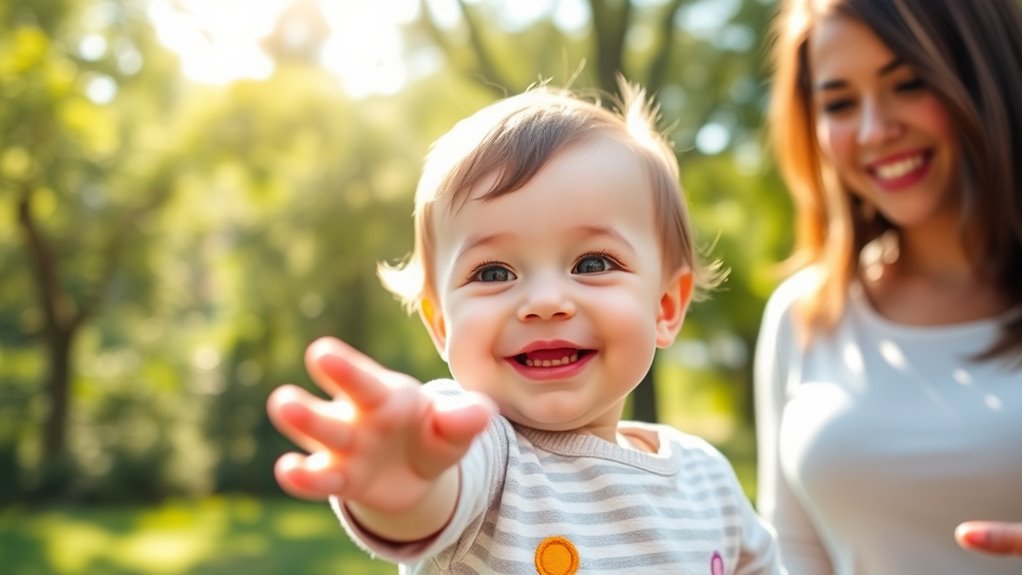
Have you ever wondered how individuals grow to interact effectively within their communities? It all begins with the social milestones they reach during early childhood. One of the first signs of social development is a child’s smile. When you see a little one smile at a familiar face or even a stranger, it signals their growing ability to connect and communicate nonverbally. These smiles are more than just adorable; they reflect a budding awareness of social cues and comfort in social settings. As children become more confident, they start to seek interactions, and playdates become a key part of this process. When kids play together, they learn essential skills like sharing, taking turns, and cooperating. For example, during a playdate, a child might offer a toy or invite a peer to join in a game, demonstrating emerging sharing behaviors. These interactions are essential because they teach children how to navigate social boundaries, express their needs, and understand others’ feelings.
As children grow, they begin to experience stranger anxiety, which is a normal part of social development. You might notice a young child cling to a parent or become wary around unfamiliar people. This reaction is a sign that they are learning to differentiate between familiar and unfamiliar faces and developing a sense of trust and security. While stranger anxiety can be challenging for parents and caregivers, it actually shows that children are developing healthy caution and awareness of their environment. Over time, as children’s social skills improve through experiences like playdates and interactions with others, the intensity of stranger anxiety typically diminishes. They start to feel more comfortable in new settings, and their confidence in social situations grows.
Social development isn’t just about individual milestones; it’s about how children learn to relate to others. They begin to understand social norms, develop empathy, and build friendships that can last a lifetime. Every interaction, from sharing a toy during a playdate to feeling shy around strangers, contributes to their social competence. Watching a child progress through these stages can be incredibly rewarding, as it shows them gaining the skills needed to form meaningful connections. Additionally, the development of social cues and nonverbal communication is crucial for effective interactions. Ultimately, these early social experiences set the foundation for their future relationships, helping them become confident, empathetic members of their communities.
As an affiliate, we earn on qualifying purchases.
Conclusion
As you observe these social milestones unfolding, remember that each smile, stranger anxiety, and connection signals a new chapter in your child’s development. But what’s truly coming next could surprise you—hidden skills and emotional depths waiting to be uncovered. Stay attentive, because these early moments are just the beginning of a fascinating journey. The future holds incredible surprises, and your child’s social world is about to expand in ways you never imagined.
Fall Picks
fall essentials
As an affiliate, we earn on qualifying purchases.