
TL;DR

Get baby and family essentials delivered free — and shop member deals
- Fast, free delivery on millions of items
- Access to Prime Big Deal Days deals on October 6–7
- Prime Video, Amazon Music and more included
Buying a prebuilt AI workstation now often saves time and reduces risk, thanks to supply shortages and price spikes. Building offers customization and control but comes with operational overhead. The best choice depends on your workload, budget, and how much effort you’re willing to invest.
Imagine you’re ready to dive into AI projects, but the choice between building or buying your workstation feels overwhelming. The landscape has changed dramatically in 2026. The old rule—build for savings, buy for speed—no longer holds universally.
Now, supply chain issues and rising component prices mean a prebuilt system might actually cost less upfront. But cost isn’t everything. Your workload, how much control you want, and how fast you need results all play into the decision.
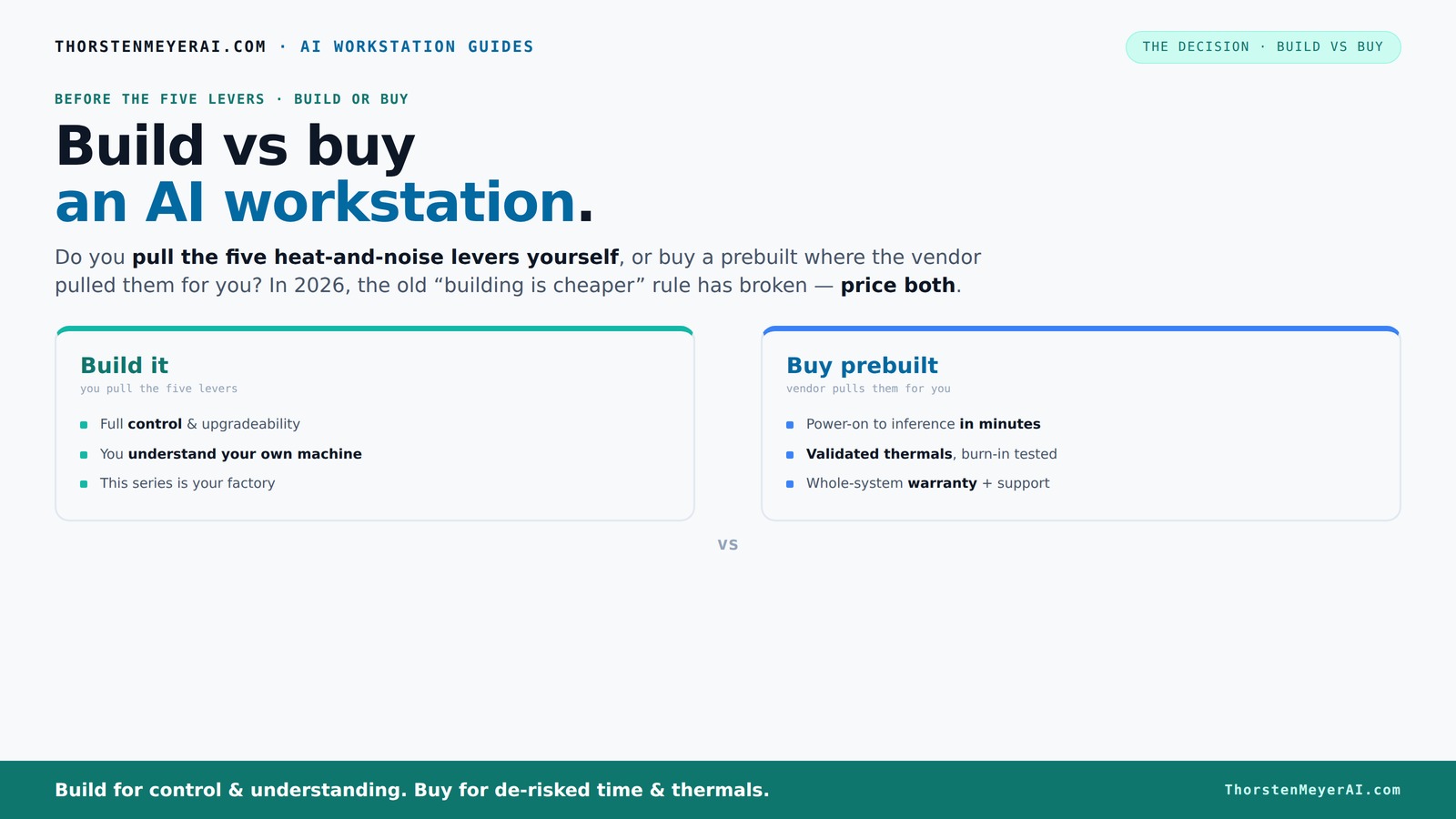
Build vs buy
an AI workstation.
The real question behind this whole series: do you pull the five heat-and-noise levers yourself, or buy a prebuilt where the vendor pulled them for you? And in 2026, the old “building is cheaper” rule has broken. Match your situation in Part 3.
Key Takeaways
- Component shortages and rising prices in 2026 mean prebuilt AI workstations are often just as affordable as DIY builds, shifting the traditional cost advantage.
- Prebuilt systems come with factory-tuned thermals, stress-tested hardware, and warranties — saving you time, effort, and risk.
- Building your own offers unmatched customization, control, and upgrade flexibility, but comes with operational overhead and technical challenges.
- A hybrid approach—buy a validated core and customize internally—often delivers the best balance for most users.
- Focus on workload needs, long-term upgrades, and support quality when choosing between build and buy.
As an affiliate, we earn on qualifying purchases.
Why the 2026 Build vs Buy Debate Is Different Than Before
In 2026, building your own AI workstation isn’t automatically cheaper. Supply shortages for GPUs, RAM, and SSDs have driven prices sky-high. A typical DIY build that once cost under $1,000 now often exceeds $1,250, sometimes more, depending on your specs. This shift means that the traditional advantage of DIY — saving money — is less clear-cut. Instead, the focus shifts to how quickly you can get a reliable, high-performance system without delays.
Meanwhile, prebuilt vendors leveraged bulk purchasing and stockpiled components before shortages worsened. This allowed them to offer systems at prices comparable to or even below what a DIY would cost today, especially when factoring in the time and effort needed to assemble and troubleshoot your own build. This economic shift implies that the decision now hinges less on initial cost and more on speed, reliability, and support. Do you want a machine tailored exactly to your needs, or a ready-to-run system that’s been tested and validated for performance?
The Real Question: Who Handles the Heat and Noise?
Building an AI workstation is akin to tuning a race car — you control every aspect, from the cooling system to airflow optimization. This level of control can lead to quieter, more efficient systems, but it requires deep knowledge of thermal dynamics and hardware tuning. If done well, it can significantly improve performance and comfort during long training sessions.
Prebuilt systems, on the other hand, often come with factory-tuned thermals that have been stress-tested by experts. Vendors run extensive thermal and noise tests to ensure the system remains stable under load, sometimes incorporating advanced cooling solutions like water-cooling or custom fans. For example, BIZON advertises systems with "up to 30% lower noise and temperature" thanks to professional factory tuning. This means you get a system that’s optimized for performance without the need for ongoing adjustments — a critical advantage for users who prioritize stability and quiet operation.
Choosing between the two involves tradeoffs: building your own offers the satisfaction and potential performance gains of customization but demands ongoing effort and expertise. Prebuilt systems provide peace of mind, consistent thermals, and lower maintenance, which can be crucial for those with limited time or technical skill.
When Buying Prebuilt Is the Smarter Move
If your schedule is tight, or you need a system ready to deploy immediately, a prebuilt system often provides the best value. It comes fully assembled, with the operating system, drivers, and AI stack pre-installed and validated. This means you can start training models or running inference tasks within minutes, dramatically reducing setup time and avoiding the pitfalls of incompatible or poorly assembled hardware.
Vendors like Lambda rigorously test their systems under sustained loads, ensuring stability during long training sessions. They also offer warranties—sometimes up to five years—and dedicated support, which can save you hours or days troubleshooting hardware issues. For users who rely on consistent performance and minimal downtime, these support features are invaluable.
High-end multi-GPU setups are particularly complex to tune and maintain. Prebuilt vendors have the expertise to optimize these configurations, ensuring they operate smoothly and efficiently. This reduces operational headaches and allows you to focus on your work rather than hardware management.
When Building Your Own AI Workstation Makes Sense
If you enjoy hardware tinkering or require a highly specific setup, building your own system offers unmatched control. You can select each component based on your exact needs—whether that’s a custom cooling solution, a particular GPU model, or specialized storage options. This level of customization allows you to optimize for specific workloads, noise levels, or power consumption, which can lead to better performance and efficiency tailored to your environment.
For example, hobbyists and students often find joy in sourcing quiet GPUs like the RTX 4070 Ti, undervolting for efficiency, and designing a case setup that minimizes noise. The process not only provides a sense of ownership but also imparts valuable technical knowledge. Moreover, you can upgrade parts gradually, spreading out costs and learning along the way.
However, this approach comes with operational overhead: troubleshooting compatibility issues, managing thermal solutions, and maintaining hardware all fall on your shoulders. For those who prefer a hands-on approach and are willing to invest time, building can be highly rewarding and cost-effective in the long run.
Cost Breakdown: Building vs Buying — What’s Really Going On?
| Aspect | Build | Prebuilt |
|---|---|---|
| Hardware Cost | Variable, often higher due to component shortages and market fluctuations; hidden costs include troubleshooting and time investment. | Often more stable and competitive thanks to bulk purchasing and vendor validation, but can include premium pricing for convenience. |
| Labor & Setup | Significant — assembling, tuning, stress-testing, and troubleshooting can take days or weeks, especially for complex multi-GPU systems. | Minimal — just unpack, connect, and configure software; ready in hours. |
| Warranty & Support | Usually absent unless purchased separately; support is DIY or through third-party providers, adding complexity. | Included, with vendor support and warranty often covering hardware issues for years, reducing risk and downtime. |
| Upgradability | High — you control every component and can upgrade as needed, future-proofing your investment. | Limited — proprietary designs or integrated components may restrict future upgrades, potentially leading to earlier obsolescence. |
The Hybrid Approach: Best of Both Worlds?
Many users now favor a hybrid strategy: purchase a prebuilt, validated core system from a reputable vendor, then customize or upgrade specific components like storage, RAM, or additional GPUs. This approach offers a balanced blend of speed, reliability, and flexibility. You benefit from the vendor’s rigorous testing and thermal optimization while retaining the ability to tailor the system to evolving needs.
For instance, you might buy a prebuilt chassis with a solid cooling system and upgrade the GPU or add more RAM later. This method reduces initial setup time and ensures a stable base, while still allowing for future customization. It’s especially advantageous if your workload fluctuates or if you want to start with a proven system and gradually optimize it over time.
Common Mistakes That Could Cost You Big
- Overbuying CPU — more cores don’t always translate to better AI performance, especially if GPU or memory bottlenecks exist.
- Ignoring cooling and power needs — thermal throttling and power supply limitations can severely reduce performance during long training runs.
- Choosing too little VRAM — insufficient memory on your GPU can bottleneck training or inference, forcing costly upgrades or limiting workload complexity.
- Underestimating noise — a noisy environment can affect focus and health; neglecting cooling solutions can lead to noisy, inefficient systems.
For example, a hobbyist purchased a high-end CPU expecting it to speed up training, only to find that GPU VRAM was the real bottleneck. Small mistakes like this can lead to unnecessary expenses, longer setup times, or subpar performance, ultimately hampering your project’s progress.
Future-Proofing Your AI Workstation: What Matters Most?
Upgrade paths and resale value are critical considerations. Building your own system generally allows for easier upgrades—swapping out GPUs, adding RAM, or expanding storage—thus extending the system’s lifespan and adaptability. Prebuilt systems often contain proprietary parts or integrated designs that limit future upgrade options, potentially leading to earlier obsolescence or costly replacements.
In the rapidly evolving AI hardware landscape, flexibility is key. A system that can be upgraded easily ensures you can adapt to new workloads or replace aging components without discarding the entire machine. For example, today’s top GPU may become outdated in two years, but a flexible system lets you swap it out without replacing the whole setup. This approach maximizes your long-term investment and reduces waste.
Frequently Asked Questions
Is it cheaper to build or buy a prebuilt AI workstation?
In 2026, component shortages and bulk buying have made prebuilt systems often as affordable as DIY builds. The real decision isn’t just price, but speed, support, and control.How much performance do I lose by buying prebuilt?
Prebuilts are usually optimized for thermal performance and reliability, so they often perform on par with custom builds, especially under sustained loads like training large models.What GPU, RAM, CPU, and storage specs do I need for my AI workload?
It depends on your task. For inference, a 16GB VRAM GPU like the RTX 4070 Ti works well. For training, 24-48GB VRAM, high-core CPUs, and fast NVMe SSDs are recommended. Check specific workload guides for detailed specs.Are prebuilt AI workstations good for local LLMs, fine-tuning, or training?
Yes, especially high-end models with multiple GPUs. They’re validated for sustained load, reducing the risk of throttling and hardware failures during long training sessions.How much upgrade room does a prebuilt workstation usually have?
It varies. Many prebuilt systems allow upgrades to RAM, storage, and sometimes GPUs, but proprietary parts can limit future expansion. Building your own generally offers more flexibility.Conclusion
In the AI era of 2026, your choice boils down to speed and simplicity versus control and customization. If you need rapid deployment and reliable support, a prebuilt system is your best bet. But if you enjoy tinkering and want to tailor every detail, building your own can deliver long-term value.
Remember: it’s not just about the initial cost — it’s about what your system needs to do tomorrow, next year, and beyond. Choose the path that aligns with your workload, skills, and patience. The right machine is out there; it’s just a matter of picking the one that fits your story.
Halloween Picks
halloween
As an affiliate, we earn on qualifying purchases.