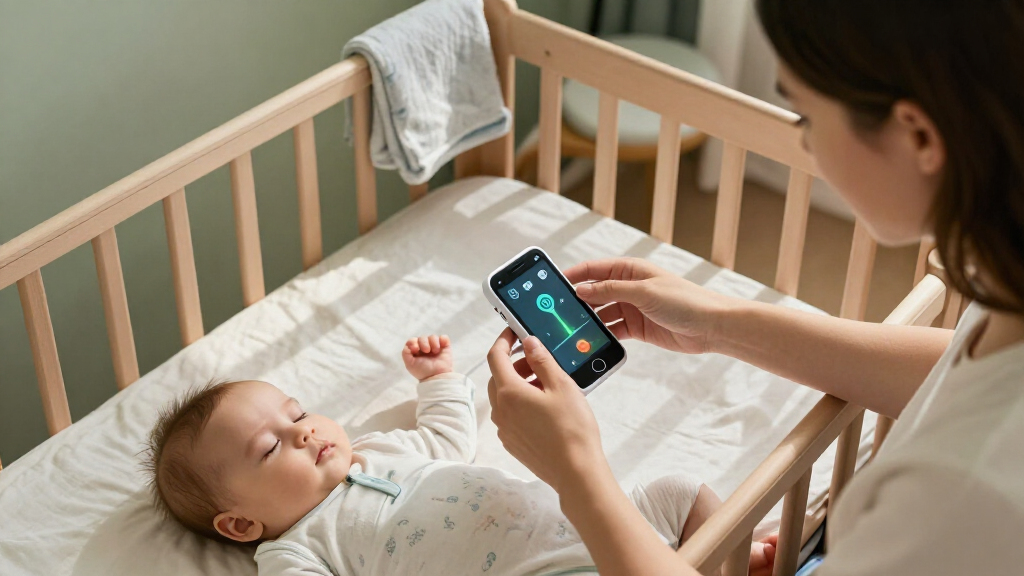

Baby monitors with breathing tracking range from wearable sensors that track a baby’s pulse and oxygen levels to pads that detect movement through the mattress. I rank the Owlet Dream Sock as the best overall for families who want wearable tracking and app-based insights, while Babysense 7 stands out for two under-mattress sensor pads and Levana Oma Sense for portable use. The main tradeoff is between the detail and connectivity of a wearable system and the simpler, less intrusive setup of movement-only monitors. Fit, mattress compatibility, charging, and alert preferences can matter as much as the tracking method. Read on for the full comparison and guidance on which style may suit your household.

Turn the school run and nap time into listening time
- Thousands of audiobooks, podcasts and originals
- Listen on your phone, tablet or Echo — also offline
- Cancel anytime
Complete the kit


Key Takeaways
- Wearable and under-mattress systems answer different needs: the Owlet Dream Sock tracks through a wearable device, while Babysense 7 and the Babysense bundle detect movement beneath the mattress.
- Owlet appears in several configurations: the Dream Sock models share a core wearable-monitoring approach, while the 3 Months of Owlet360 version adds a service component rather than a different sensor style.
- Two sensor pads distinguish Babysense 7: its coverage approach may appeal to families who want a crib-based monitor, but mattress and setup compatibility still need checking.
- Portability is Levana Oma Sense’s defining tradeoff: its clip-on movement monitor avoids a fixed sensor-pad arrangement, though it does not provide the same type of app-based data as the Owlet options.
- The Babysense bundle combines video and movement monitoring: it may suit buyers who want both functions in one purchase, while families focused on wearable tracking should compare it with the Owlet lineup.
| BEMPU Baby Movement Monitor – Sleep Monitor with Gentle Vibration Alerts |  | Best for Wi-Fi-Free Movement Alerts | Brand: BEMPU | Model: BBBV20 | Sensor: Motion sensor tracking abdominal movement | VIEW LATEST PRICE | See Our Full Breakdown |
| Owlet Dream Sock Smart Baby Monitor |  | Best Overall for Pulse and Oxygen Tracking | Intended age: 1–18 months | Intended weight: 6–30 lb | Measurements: Pulse rate and oxygen levels | VIEW LATEST PRICE | See Our Full Breakdown |
| Owlet Dream Sock Smart Baby Monitor |  | Best for Sleep-Pattern Insights | Intended age: 1–18 months | Intended weight: 6–30 lb | Measurements: Pulse rate and oxygen levels | VIEW LATEST PRICE | See Our Full Breakdown |
| Owlet Dream Sock Smart Baby Monitor |  | Best for Base Station and Phone Alerts | Intended age: 1–18 months | Intended weight: 6–30 lb | Measurements: Pulse rate and oxygen levels | VIEW LATEST PRICE | See Our Full Breakdown |
| Owlet Dream Sock Smart Baby Monitor with 3 Months of Owlet360 |  | Best for Added Owlet360 Insights | Intended age: 1–18 months | Intended weight: 6–30 lb | Measurements: Pulse rate and oxygen levels | VIEW LATEST PRICE | See Our Full Breakdown |
| Babysense 7 Baby Movement Monitor with Two Sensor Pads |  | Best Non-Wearable Movement Monitor | Brand: Babysense | Model: BS7 | Sensor pads: 2 | VIEW LATEST PRICE | See Our Full Breakdown |
| Levana Oma Sense Portable Baby Breathing Movement Monitor |  | Best for Wireless-Free Wearable Alerts | Monitoring method: Tracks abdominal movement | Initial alert: Randomized vibrations after 15 seconds without detected movement | Audible alarm: Sounds if movement is not re-established within 5 seconds after the initial alert | VIEW LATEST PRICE | See Our Full Breakdown |
| Babysense Baby Monitor Bundle with Video Monitor and Under-Mattress Movement Monitor |  | Best Movement-and-Video Bundle | Brand: Babysense | Model: V24R + BS7 | Video monitor display: 2.4 inches | VIEW LATEST PRICE | See Our Full Breakdown |
| baby monitors with breathing tracking | Connectivity | Battery life | Intended age | Intended weight |
|---|---|---|---|---|
| BEMPU Baby Movement Monitor | Bluetooth Low Energy; no Wi-Fi required | Up to 7 days (56 hours) per charge | — | — |
| Owlet Dream Sock Smart Baby Mo | Bluetooth and 2.4 GHz Wi-Fi | Up to 16 hours | 1–18 months | 6–30 lb |
| Owlet Dream Sock Smart Baby Mo | Bluetooth and 2.4 GHz Wi-Fi | 16 hours | 1–18 months | 6–30 lb |
| Owlet Dream Sock Smart Baby Mo | Bluetooth and 2.4 GHz Wi-Fi | 16 hours | 1–18 months | 6–30 lb |
| Owlet Dream Sock Smart Baby Mo | Bluetooth and 2.4 GHz Wi-Fi | Up to 16 hours | 1–18 months | 6–30 lb |
| Babysense 7 Baby Movement Moni | — | — | — | — |
| Levana Oma Sense Portable Baby | No Wi-Fi, radio, or Bluetooth | — | — | — |
| Babysense Baby Monitor Bundle | No Wi-Fi or app required | — | — | — |
More Details on Our Top Picks
BEMPU Baby Movement Monitor – Sleep Monitor with Gentle Vibration Alerts
The BEMPU is the clearest fit for caregivers who want abdominal movement tracking without Wi-Fi. Its clip-on sensor watches for gentle movement and uses a two-step alert: vibration first, then an audible alarm if movement is still not detected. That approach differs from the Owlet Dream Sock, which tracks pulse rate and oxygen levels rather than abdominal motion. BEMPU is also lighter and more portable than an under-mattress option such as the Babysense 7, though it depends on a Bluetooth connection to the caregiver’s device for app notifications. Its reported battery life of up to seven days between charges is a practical advantage over the Owlet’s 16-hour battery window. The main compromise is Bluetooth range, which may be limiting in a larger home; buyers should also distinguish movement monitoring from medical diagnosis.
Pros:- Tracks gentle abdominal movement and alerts when movement is not detected.
- Vibration followed by an audible alarm provides a staged alert sequence.
- Works without Wi-Fi and supports Android and iOS devices.
- Lightweight 13 g clip-on design and up to seven days of stated battery life.
Cons:- Bluetooth range may limit phone notifications in larger homes.
- Tracks movement rather than pulse rate or oxygen levels.
- Requires the device to be charged, even with its comparatively long battery life.
Best for: Caregivers who want a lightweight, wearable abdominal-movement monitor with app alerts and no Wi-Fi setup.
Not ideal for: Families in larger homes who need dependable alerts at a distance beyond Bluetooth range, or buyers specifically seeking pulse and oxygen readings.
- Brand:BEMPU
- Model:BBBV20
- Sensor:Motion sensor tracking abdominal movement
- Connectivity:Bluetooth Low Energy; no Wi-Fi required
- Compatible devices:Android, iPhone, smartphones, and tablets
- Battery life:Up to 7 days (56 hours) per charge
- Charging time:Approximately 1 hour
- Weight and dimensions:13 g; 1.4 × 1.5 × 0.5 inches
- Warranty:1-year manufacturer warranty
Our verdict“Choose BEMPU for wearable movement monitoring without Wi-Fi, but choose an Owlet Dream Sock if pulse and oxygen readings matter more.”
Owlet Dream Sock Smart Baby Monitor
Among these picks, this Owlet Dream Sock is the strongest match for families who want real-time pulse-rate and oxygen-level readings alongside phone and Base Station alerts. That makes it a different kind of breathing-related monitor from the BEMPU, which tracks abdominal movement instead of vital-sign readings. Sleep trends and wake-window insights add context that the Babysense 7’s under-mattress movement setup does not provide. The tradeoff is a narrower fit window: it is intended for healthy infants aged 1–18 months who weigh 6–30 pounds, and it is listed for U.S. use only. Setup also requires 2.4 GHz Wi-Fi, so a 5 GHz-only network is a barrier. Its 16-hour battery life means families need a regular charging routine, unlike BEMPU’s longer stated interval between charges.
Pros:- Tracks pulse rate and oxygen levels in real time.
- Sends alerts to both the Base Station and phone when readings leave preset zones.
- Includes sleep trends and wake-window insights.
- Uses 256-bit encryption and elliptic curve authentication.
Cons:- Requires 2.4 GHz Wi-Fi and does not support 5 GHz Wi-Fi.
- Intended only for healthy infants within specified age and weight ranges.
- A 16-hour battery life calls for regular recharging.
Best for: U.S. caregivers of healthy infants aged 1–18 months and weighing 6–30 pounds who want pulse and oxygen readings with app and Base Station alerts.
Not ideal for: Families outside the United States, households without 2.4 GHz Wi-Fi, or caregivers seeking a movement-only monitor without a wearable sock.
- Intended age:1–18 months
- Intended weight:6–30 lb
- Measurements:Pulse rate and oxygen levels
- Alert destinations:Base Station and phone
- Battery life:Up to 16 hours
- Connectivity:Bluetooth and 2.4 GHz Wi-Fi
- Data security:256-bit encryption and elliptic curve authentication
- Regional compatibility:United States only
Our verdict“Pick this Dream Sock if you want pulse and oxygen tracking for an eligible U.S. infant and can meet its Wi-Fi and charging requirements.”
Owlet Dream Sock Smart Baby Monitor
This Dream Sock is a good fit for caregivers who value predictive sleep insights as well as live pulse and oxygen readings. Its core monitoring overlaps with the other Owlet Dream Sock listings here, so the deciding distinction is the product information’s emphasis on sleep prediction rather than just alerts and general sleep trends. Compared with BEMPU, it reports different measurements: pulse and oxygen instead of abdominal movement. It also relies on 2.4 GHz Wi-Fi for setup, while BEMPU can work without Wi-Fi, making network compatibility a meaningful dividing line. The sock is limited to healthy infants aged 1–18 months weighing 6–30 pounds and is listed for U.S. use only. A 16-hour battery life is workable with a charging routine, but less forgiving than BEMPU’s stated multi-day interval.
Pros:- Provides real-time pulse-rate and oxygen-level measurements.
- Sends alerts to the Base Station and phone when readings leave preset zones.
- Predictive sleep insights add information beyond live readings.
- Uses 256-bit encryption and elliptic curve authentication.
Cons:- Requires 2.4 GHz Wi-Fi for setup and is not compatible with 5 GHz during setup.
- Limited to U.S. use and the listed infant age and weight range.
- The 16-hour battery life requires frequent charging compared with BEMPU’s stated battery interval.
Best for: U.S. families with an eligible infant who want live pulse and oxygen readings plus predictive sleep information.
Not ideal for: Caregivers who need Wi-Fi-free operation, are outside the United States, or want a breathing-movement sensor rather than a wearable vital-sign monitor.
- Intended age:1–18 months
- Intended weight:6–30 lb
- Measurements:Pulse rate and oxygen levels
- Connectivity:Bluetooth and 2.4 GHz Wi-Fi
- Wi-Fi compatibility:2.4 GHz only; not compatible with 5 GHz during setup
- Battery life:16 hours
- Materials:Nylon and spandex
- Data security:256-bit encryption and elliptic curve authentication
- Availability:United States only
Our verdict“Choose this version if predictive sleep insights matter alongside pulse and oxygen monitoring and your home meets its U.S. and Wi-Fi requirements.”
Owlet Dream Sock Smart Baby Monitor
This listing suits families who want the same-device alert path to a Base Station and phone when pulse or oxygen readings leave preset zones. Compared with BEMPU’s vibration-then-audio sequence for missed abdominal movement, the Owlet monitors pulse rate and oxygen levels; those are different approaches, not interchangeable features. It also provides sleep trends and wake-window insights, while the Babysense 7 focuses on movement detection beneath the mattress. The Owlet’s value depends on a specific fit: the infant must be healthy, aged 1–18 months, and weigh 6–30 pounds. It also needs 2.4 GHz Wi-Fi and is listed for U.S. use only. The 16-hour battery life adds a charging task that BEMPU’s stated seven-day battery interval avoids.
Pros:- Tracks pulse rate and oxygen levels in real time.
- Alerts are sent to the Base Station and phone when readings leave preset zones.
- Includes sleep trends and wake-window insights.
- Uses encrypted data protection with 256-bit encryption and elliptic curve authentication.
Cons:- Works with 2.4 GHz Wi-Fi only.
- Regional and infant age-and-weight restrictions limit who can use it.
- Requires recharging after up to 16 hours of use.
Best for: U.S. caregivers who want both Base Station and phone alerts for an eligible infant’s pulse and oxygen readings.
Not ideal for: Families using only 5 GHz Wi-Fi, those outside the United States, or buyers who prefer an under-mattress or Wi-Fi-free movement monitor.
- Intended age:1–18 months
- Intended weight:6–30 lb
- Measurements:Pulse rate and oxygen levels
- Alerts:Base Station and phone
- Battery life:16 hours
- Connectivity:Bluetooth and 2.4 GHz Wi-Fi
- Data security:256-bit encryption and elliptic curve authentication
- Regional compatibility:United States only
Our verdict“This Dream Sock fits eligible U.S. families who want dual-device alerts, but not homes that need Wi-Fi-free movement monitoring.”
Owlet Dream Sock Smart Baby Monitor with 3 Months of Owlet360
This bundle is the clearest choice for families who want the Dream Sock’s pulse and oxygen monitoring plus a defined three-month Owlet360 inclusion. Its core readings and alert setup match the other Owlet Dream Sock options in this roundup; the added Owlet360 access is the distinguishing feature, not a different breathing sensor. That makes it a more insight-oriented choice than BEMPU, which tracks abdominal movement and works without Wi-Fi. The Sock instead requires 2.4 GHz Wi-Fi and sends alerts through the Base Station and phone when readings leave preset zones. Its 16-hour battery life also means regular charging, and its U.S. version is intended for healthy infants aged 1–18 months weighing 6–30 pounds. Buyers who only want movement alerts may find BEMPU or the Babysense 7 a closer match.
Pros:- Tracks pulse rate and oxygen levels with alerts on the Base Station and phone.
- Includes three months of Owlet360.
- Provides sleep and wellness insights alongside monitoring.
- Uses 256-bit encryption and elliptic curve authentication.
Cons:- Requires 2.4 GHz Wi-Fi and does not support 5 GHz for the Sock.
- The U.S. version is limited to use in the United States.
- Intended for healthy infants aged 1–18 months weighing 6–30 pounds, with up to 16 hours of battery life.
Best for: U.S. caregivers of eligible infants who want pulse and oxygen readings and plan to use the included three months of Owlet360 insights.
Not ideal for: Families outside the United States, homes without 2.4 GHz Wi-Fi, or buyers who do not want a wearable sock or Owlet360 features.
- Intended age:1–18 months
- Intended weight:6–30 lb
- Measurements:Pulse rate and oxygen levels
- Connectivity:Bluetooth and 2.4 GHz Wi-Fi
- Wi-Fi compatibility:2.4 GHz required; not compatible with 5 GHz
- Battery life:Up to 16 hours
- Included subscription:3 months of Owlet360
- Data security:256-bit encryption and elliptic curve authentication
- Regional compatibility:U.S. version; for use in the United States
Our verdict“Choose this bundle if you want Owlet360 insights with the Dream Sock and meet its U.S., Wi-Fi, and infant-fit requirements.”
Babysense 7 Baby Movement Monitor with Two Sensor Pads
The Babysense 7 suits families who want movement alerts without attaching anything to the baby. Its two under-mattress sensor pads cover more of the crib than a single-pad setup, while the control unit alerts with sound and a flashing light if movement stops for 20 seconds or drops below the stated threshold. Compared with the Levana Oma Sense, it avoids a wearable clip and its vibration alert, making it a better fit for caregivers who prefer monitoring to happen beneath the mattress. The tradeoff is that Babysense 7 tracks movement only: there is no video or audio monitoring to check on the baby remotely. Pad placement and mattress compatibility also matter to its operation, and the battery-powered system requires keeping the control unit powered.
Pros:- Two pads provide movement coverage across the crib
- No wearable or direct contact with the baby
- Audible alarm and flashing light signal reduced or stopped movement
- Battery-operated control unit does not require Wi-Fi
Cons:- Does not provide video or audio monitoring
- Sensor pads must be positioned correctly beneath the mattress
- Requires batteries to power the control unit
Best for: Caregivers who want non-contact movement alerts across the crib and already have a separate way to see or hear the baby
Not ideal for: Parents seeking a camera, live audio, or wearable movement tracking in one system
- Brand:Babysense
- Model:BS7
- Sensor pads:2
- Monitoring type:Non-contact, under-mattress movement monitoring
- Alarm trigger:No movement for 20 seconds or fewer than 10 micro-movements per minute
- Power:Battery-operated
- Included components:2 sensor pads, control unit, control unit holder, hanging hook, user manual
- Warranty:1 year
Our verdict“Choose the Babysense 7 if you want crib-wide, non-wearable movement alerts and do not need video or audio in the same device.”
Levana Oma Sense Portable Baby Breathing Movement Monitor
The Levana Oma Sense is the portable choice for caregivers who want movement alerts without Wi-Fi, radio, or Bluetooth. It clips over a diaper, pants, or a buttoned-up onesie, so it avoids skin contact while tracking abdominal movement. If it detects no movement for 15 seconds, it gives a randomized vibration alert; an audible alarm follows if movement is not re-established within five more seconds. That staged alert sets it apart from the Babysense 7, which uses pads beneath the mattress and sounds an alarm when its movement threshold is crossed. The Levana is easier to move between suitable sleep spaces, but it requires a clip to stay in position and is specified for ages 0–6 months. It also offers no camera or remote monitoring feed.
Pros:- Provides vibration followed by an audible alert
- Clips over clothing or a diaper without skin contact
- Uses no Wi-Fi, radio, or Bluetooth
- Portable format can suit families moving between compatible sleep spaces
Cons:- Designed only for infants aged 0–6 months
- Must be clipped in position over clothing or a diaper
- An audible alarm follows if movement is not re-established after the vibration alert
Best for: Caregivers of infants aged 0–6 months who want a portable movement monitor without wireless connectivity
Not ideal for: Families wanting monitoring beyond six months, a camera, or an under-mattress system that needs no wearable clip
- Monitoring method:Tracks abdominal movement
- Initial alert:Randomized vibrations after 15 seconds without detected movement
- Audible alarm:Sounds if movement is not re-established within 5 seconds after the initial alert
- Skin contact:None
- Connectivity:No Wi-Fi, radio, or Bluetooth
- Age range:0–6 months
- Materials:Medical-grade materials
- Status indicator:Flashing blue light
Our verdict“Pick the Levana Oma Sense for a portable, wireless-free wearable alert system during the first six months, not for camera monitoring or longer-term use.”
Babysense Baby Monitor Bundle with Video Monitor and Under-Mattress Movement Monitor
This Babysense bundle combines two kinds of monitoring: the BS7’s under-mattress movement alerts and a camera system with night vision, temperature alerts, and two-way audio. That makes it a more complete in-room setup than the standalone Babysense 7, which tracks movement but has no video. The system also works without Wi-Fi or an app, a practical distinction for families who want a dedicated monitor rather than phone-based access. Its compromises are tied to that bundled format: the listed screen is just 2.4 inches, and movement tracking depends on correctly positioning both sensor pads beneath the mattress. Compared with the wearable Levana Oma Sense, this option avoids attaching a device to the baby, but it is less portable between sleep spaces and requires setting up the camera and pads.
Pros:- Pairs two under-mattress movement sensor pads with video monitoring
- Video monitor includes night vision, temperature alerts, and two-way audio
- Operates without Wi-Fi or an app
- Camera system can expand to support up to four cameras
Cons:- The listed video display is 2.4 inches
- Movement monitoring depends on correct sensor-pad placement beneath the mattress
- Less portable between sleep spaces than the wearable Levana Oma Sense
Best for: Families who want non-contact movement alerts alongside a dedicated camera, night vision, temperature alerts, and two-way audio
Not ideal for: Caregivers who want a large viewing screen, a portable wearable monitor, or app-based remote access
- Brand:Babysense
- Model:V24R + BS7
- Video monitor display:2.4 inches
- Movement sensor pads:2
- Movement alarm:Sounds if no movement is detected within 20 seconds or movement falls below 10 micro-movements per minute
- Connectivity:No Wi-Fi or app required
- Camera expandability:Up to 4 cameras
- Video features:Temperature alerts, night vision, and two-way audio
- Warranty:1 year
Our verdict“Choose this bundle if you want a dedicated no-app video monitor and non-contact movement alerts in one setup, and can work with its small display.”

How We Picked
I compared the eight listed options by the kind of breathing or movement information they provide, how the sensor is worn or installed, and what a caregiver must do to use the system consistently. I also weighed alert approach, portability, video or app features where specified, setup demands, and likely fit with different sleep spaces. These factors shape daily usefulness more than a long feature list alone.
The ranking favors options with a clear fit for common buyer priorities and meaningful distinctions within this lineup. Owlet Dream Sock ranks first for its wearable tracking approach and connected features; Babysense 7 follows for families who prefer under-mattress sensing and two pads. The portable Levana and the Babysense video bundle serve narrower needs, while the repeated Dream Sock listings are treated as separate configurations rather than assumed to be identical. A monitor’s breathing or movement alerts are not a substitute for safe-sleep practices or medical advice, and I do not treat any device as a guarantee against harm.
| baby monitors with breathing tracking | Connectivity |
|---|---|
| BEMPU Baby Movement Monitor | Bluetooth Low Energy; no Wi-Fi required |
| Owlet Dream Sock Smart Baby Mo | Bluetooth and 2.4 GHz Wi-Fi |
| Owlet Dream Sock Smart Baby Mo | Bluetooth and 2.4 GHz Wi-Fi |
| Owlet Dream Sock Smart Baby Mo | Bluetooth and 2.4 GHz Wi-Fi |
| Owlet Dream Sock Smart Baby Mo | Bluetooth and 2.4 GHz Wi-Fi |
| Babysense 7 Baby Movement Moni | — |
| Levana Oma Sense Portable Baby | No Wi-Fi, radio, or Bluetooth |
| Babysense Baby Monitor Bundle | No Wi-Fi or app required |
Factors to Consider When Choosing Baby Monitors With Breathing Tracking
Before choosing a device, decide what you want the monitor to tell you and how much setup you are willing to manage. These broader checks can prevent a mismatch that product feature lists may not make obvious.
Choose the type of tracking you actually want
Wearable monitors and movement pads do not measure the same things, so compare the stated function rather than treating every breathing monitor as interchangeable. A wearable may collect additional readings, while an under-mattress pad detects movement according to its design. A portable clip-on option can be easier to move between sleep spaces, but it may offer fewer connected features. Decide whether your priority is a wearable reading, movement alerts, or a broader video-and-monitor setup. Avoid assuming that a movement alert confirms normal breathing or that a lack of an alert guarantees safety. If you have a medical concern, ask your child’s clinician what monitoring, if any, is appropriate.
Check fit with the baby’s sleep space
Sensor placement depends on the crib, mattress, and intended sleep arrangement. Under-mattress systems may have specific requirements for mattress construction, support, and sensor position, so check the manufacturer’s instructions before buying. Wearable devices need a suitable fit and may require a correctly sized sensor or sock as a baby grows. Portable monitors also need to attach as directed and stay positioned as intended. A common mistake is choosing based only on the nursery setup today, without considering a bassinet, travel crib, or later change in sleep space. If the product’s stated compatibility is unclear, resolve that before relying on it.
Think through alerts, not just readings
An alert is useful only if caregivers can hear or see it, understand what it means, and respond according to the product instructions. Compare whether the system alerts through a base unit, phone, or both, and check what happens if a phone is muted or the connection drops. Consider who is responsible overnight when more than one caregiver is present. Frequent false or confusing alerts can disrupt sleep and reduce trust, so learn how the manufacturer describes alerts and limitations. Do not silence or change alert settings without understanding the consequences. A monitor should support a caregiver’s routine, not replace direct checks or professional guidance.
Include charging, cleaning, and ongoing upkeep
Wearable options can add charging and fit checks to the bedtime routine, while sensor pads may require careful installation and periodic checks of their connections. Ask how often the wearable needs charging, whether you have a spare component, and how the parts should be cleaned. For app-connected monitors, check device compatibility and whether the household’s Wi-Fi or phone access is dependable where the baby sleeps. Bundled service features may have terms that differ from the hardware, so review what is included and what continues after the stated period. Small upkeep tasks matter because an uncharged or incorrectly installed monitor cannot perform as intended. Choose the routine your household can follow consistently.
Pay for features that match your priorities
More data, video, and app connectivity can be useful, but they also bring more setup and more information to interpret. If you mainly want movement alerts in a fixed crib, a simpler pad-based monitor may be a better match than a connected wearable system. If seeing video and movement monitoring together matters, a bundle can reduce the need to coordinate separate devices. Compare the actual hardware and included services across versions, especially when product names are similar. Do not assume a service add-on changes the monitor’s sensor capabilities. Spend extra only when the added function solves a real need in your household.
Frequently Asked Questions
Do breathing-tracking monitors measure breathing in the same way?
No. This lineup includes a wearable sock, under-mattress movement sensors, and a portable clip-on movement monitor, and those methods should not be treated as equivalent. Some products track additional readings, while others detect movement and provide an alert based on their design. Read the manufacturer’s description to learn exactly what is measured and what triggers an alert. If you need monitoring for a health condition, ask a clinician which measurements are relevant rather than choosing by the broad label “breathing monitor.”
Should I choose an Owlet Dream Sock or an under-mattress monitor?
Choose based on the form of monitoring and daily routine you prefer, not on the idea that one method is automatically better for every family. The Dream Sock is a wearable, connected approach, while Babysense 7 uses two sensor pads beneath the mattress. A wearable means managing fit and charging; pads mean checking mattress compatibility and installation. If you want video alongside movement monitoring, the Babysense bundle is another distinct option. Compare the manufacturer’s stated readings, alerts, and setup instructions before deciding.
Will an under-mattress movement monitor work with any crib mattress?
Do not assume it will. Mattress construction, thickness, support, and the monitor’s required placement can affect whether a pad is suitable for a particular sleep space. Check the exact model’s compatibility instructions and confirm how the sensor must be positioned before purchase. If you plan to use a bassinet or travel crib as well as a standard crib, verify each setup separately. A device that does not match the sleep surface may not function as intended.
Is a monitor with more readings necessarily the safer choice?
More readings do not automatically make a monitor safer or easier to use. Additional data can be useful for some families, but it also requires understanding what the readings mean and what the device can and cannot detect. No consumer monitor should be treated as a guarantee against harm or a replacement for safe-sleep guidance, caregiver checks, or medical care. If you are considering monitoring because of a health concern, discuss the decision with your child’s clinician. Choose features that answer a clear need rather than collecting data for its own sake.
What should I compare between the different Owlet Dream Sock listings?
Start by checking whether the listing is for the same Dream Sock hardware and identify any included service or bundle differences. The listed options include repeated Dream Sock entries as well as a version with three months of Owlet360, so do not assume every listing has identical inclusions. Confirm what comes in the box, the app or service terms, device compatibility, and any ongoing requirements directly with the seller or manufacturer. The added service may affect the connected experience, but it should not be confused with a different sensor method. If the details are unclear, compare model identifiers before choosing.
Conclusion
Best overall: I would start with the Owlet Dream Sock for buyers who want wearable tracking and connected features. Best value in approach: Babysense 7 is the clearest fit for families who prefer two under-mattress sensor pads over a wearable; compare included components and compatibility before purchase. Best premium-style option: the Dream Sock with three months of Owlet360 suits buyers who specifically want the added service, after checking its terms. Best for beginners: Levana Oma Sense may suit caregivers seeking a portable, movement-focused device without a fixed under-mattress setup, though they should be comfortable with its more limited scope. Best for specific needs: choose the Babysense bundle if video and movement monitoring together matter, or the regular Dream Sock if wearable readings are the priority. The right choice is the one whose tracking method, setup, and alerts your household can use as directed.
Fall Picks
fall essentials
As an affiliate, we earn on qualifying purchases.