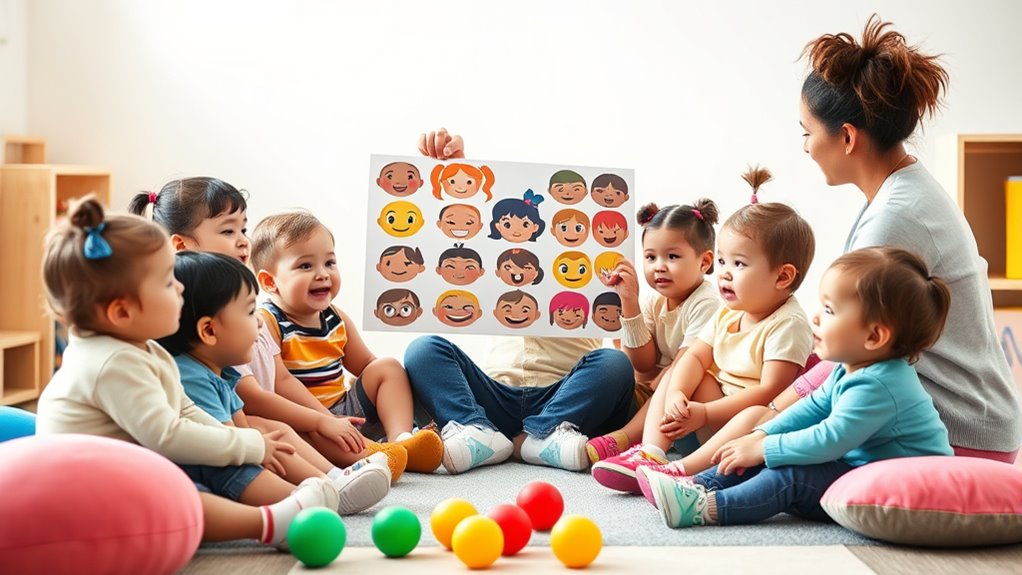

To teach toddlers about feelings, name emotions during daily moments and describe situations to help them connect words with experiences. Model expressing your own feelings openly, using simple labels like “happy” or “upset.” Ask questions to encourage self-awareness and validate their emotions to build trust. Supporting empathy by discussing others’ feelings fosters caring behaviors. If you keep exploring these strategies, you’ll discover more ways to nurture your child’s emotional growth effectively.
Key Takeaways
- Name and label emotions during daily interactions to help toddlers connect feelings with situations.
- Model emotional expression and management openly to teach children that feelings are normal and manageable.
- Use simple questions like “Are you feeling sad or angry?” to promote emotional self-awareness.
- Encourage children to share their feelings and validate their emotions to foster trust and understanding.
- Teach empathy by asking children how others might feel and responding compassionately to their emotional cues.
Understanding and managing emotions isn’t just important for adults; it starts in early childhood. As a caregiver or parent, you play an essential role in helping your toddler develop emotional intelligence, which lays the foundation for healthy relationships and social skills later in life. One of the first steps is teaching your child about emotion recognition. Young children often experience feelings intensely but may struggle to identify or label them accurately. You can help by naming emotions during daily interactions, like saying, “You look upset because your toy broke,” or “You’re happy because you got a hug.” These simple labels help your toddler connect feelings to specific situations, making emotion recognition clearer and more accessible. Incorporating emotional awareness exercises can further support your child’s understanding of their feelings.
When you model recognizing and expressing emotions yourself, your child learns through observation. For example, when you feel frustrated, verbalize it: “I’m feeling a little annoyed because I can’t find my keys.” This shows your toddler that emotions are normal and manageable. As they become more capable of identifying their feelings, you can encourage them to share what they’re experiencing. Asking questions like, “Are you feeling sad or angry?” or “Can you tell me what made you upset?” helps your child become more aware of their emotional states.
Empathy development also begins early and is closely tied to emotion recognition. When you respond empathetically to your toddler’s feelings, you’re teaching them to understand others’ emotions as well. If your child is crying because they fell, instead of dismissing their tears, you might say, “That hurt, didn’t it? I know falling can be upset.” This validates their feelings and shows that you understand and care. Over time, your child will start to recognize similar emotions in others, developing empathy naturally. You can foster this by encouraging your child to consider how others might feel in different situations, asking questions like, “How do you think your friend feels after losing the toy?” or “What can you do to help when someone is sad?”
Conclusion
Teaching toddlers about feelings is like planting seeds in a garden—you nurture their emotional growth with patience and care. As they learn to recognize and express emotions, they build a strong foundation for healthy relationships and self-awareness. Remember, your guidance is the sun that helps these tiny seeds bloom into confident, emotionally intelligent individuals. With your support, they’ll navigate feelings like a boat sailing smoothly across calm waters, ready to face life’s challenges with resilience.