

To boost your toddler’s brain power, try engaging them with simple memory games that stimulate their senses and motor skills. Use textured, colorful, or scented cards for pattern matching, hiding objects for recall, or pairing items to strengthen memory and concentration. Incorporate activities that challenge their fine motor skills, like picking up or sorting objects. Keep activities fun and varied to maintain interest, and discovering more innovative ideas will help develop their cognitive abilities even further.
Key Takeaways
- Use matching pairs of textured, scented, or colorful cards to enhance pattern recognition and sensory engagement.
- Incorporate hide-and-seek activities with familiar objects to stimulate memory and sensory processing.
- Vary textures, sounds, and visuals regularly to keep toddlers engaged and promote multisensory learning.
- Encourage fine motor skills through activities like flipping, sorting, and grasping different tactile objects.
- Repetition of memory games helps strengthen neural connections, concentration, and problem-solving abilities.
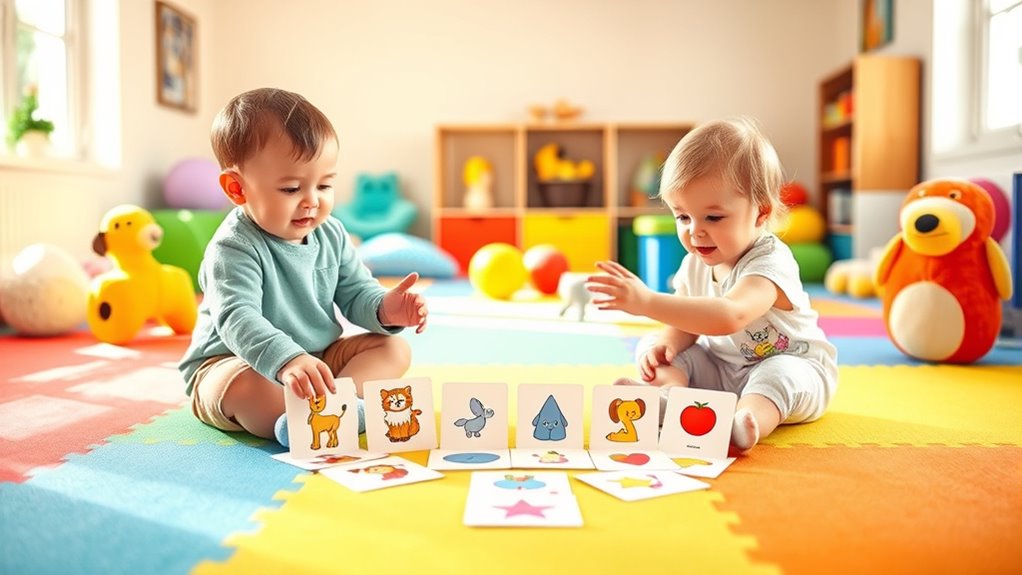
Memory games are a fantastic way to support your toddler’s cognitive development while keeping them engaged and entertained. These games not only boost memory and concentration but also provide opportunities for sensory play, which is vital during early childhood. When you incorporate sensory elements into memory activities, you stimulate your child’s senses—touch, sight, sound, and even smell—making the experience more immersive and memorable. For example, using textured cards or objects with different colors and scents can enhance their sensory exploration, helping them form stronger mental associations. As your toddler manipulates small objects or matches different textures, they also improve their fine motor skills. Picking up, placing, or flipping cards requires hand-eye coordination and precise movements, which are fundamental for developing their dexterity.
Engaging your toddler in simple memory games with colorful, textured pieces encourages active participation. You might hide a familiar object under a cloth and ask them to find it, stimulating their sensory processing and memory recall simultaneously. These activities can be easily adapted, like matching pairs of textured or scented cards, which reinforces their ability to recognize patterns and remember locations or objects. As they play, you’ll notice their concentration and problem-solving skills strengthen, laying a foundation for more complex cognitive tasks later on.
The key to making these games effective is variety. Incorporate different textures, colors, and sounds to keep your toddler curious and enthusiastic to explore. Use items that require them to use their fingers delicately or grasp objects firmly, which promotes fine motor development. For instance, sorting small objects by shape or texture sharpens their hand movements and coordination. As they repeatedly practice these motions, they become more confident in their fine motor abilities, which are essential for tasks like writing or buttoning clothes in the future. Additionally, choosing colorful and textured items that support sensory exploration can significantly enhance their learning experience.
Conclusion
By playing these memory games, you’re opening your toddler’s brain like a superhero unlocking secret powers. Soon, they’ll remember everything from where you left their favorite toy to the names of every animal in the zoo! Keep these games fun and frequent, and watch their brain grow faster than a rocket zooming to the stars. You’re not just playing; you’re transforming your little one into a memory master who could out-remember an elephant with a photographic memory!