
Yes, infants do have an innate number sense. From a very young age, they can recognize and differentiate between small quantities without needing formal schooling. They notice patterns, compare amounts, and understand differences like “more” or “less.” This early awareness helps lay the foundation for later math skills such as counting and arithmetic. If you want to see how these abilities develop further, keep exploring this fascinating area of infant cognition.
Key Takeaways
- Infants possess an innate number sense, allowing them to distinguish between different quantities from birth.
- They can recognize differences in small sets, such as two versus three objects, without counting.
- Early exposure and interactions enhance infants’ natural ability to compare and understand quantities.
- Babies can detect numerical patterns and regularities, foundational for later mathematical skills.
- These innate number abilities support future development of counting, arithmetic, and mathematical reasoning.

Have you ever wondered how babies start to understand numbers? It’s a fascinating area of study that reveals how even the youngest infants possess a remarkable sense of numerical cognition. From the moment they’re born, babies are tuned into their environment in ways that suggest they’re more perceptive about quantities than you might expect. Researchers have found that infants exhibit early quantitative skills, meaning they can differentiate between different amounts without formal training. This ability forms the foundation of how they eventually learn to count and grasp more complex mathematical concepts later in life.
Infants have an innate sense of numbers and can distinguish quantities from a young age.
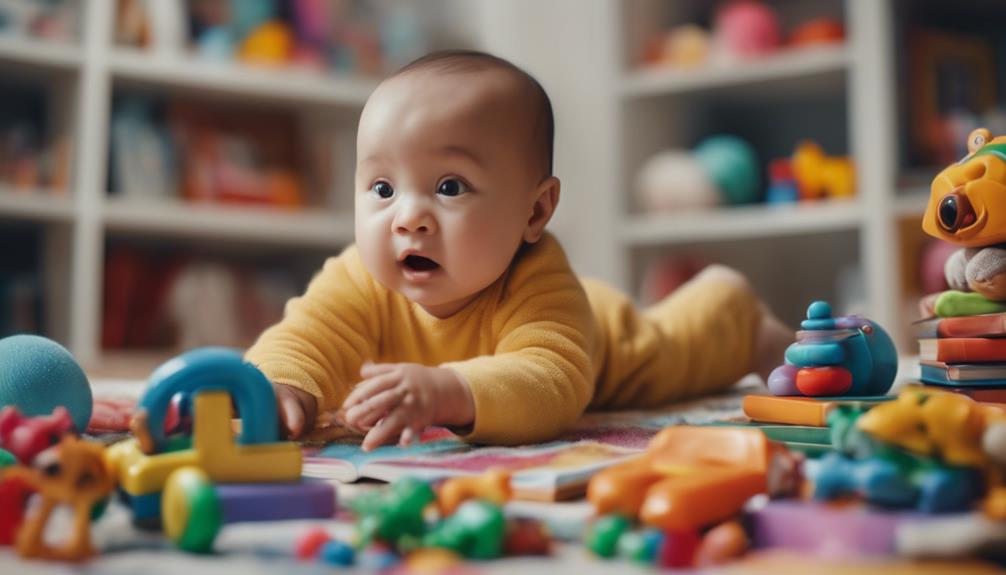
When you watch a baby reach for a toy or notice how they react to different quantities of objects, you’re observing their nascent numerical cognition. For example, studies have shown that infants as young as six months can distinguish between small sets of objects—such as two versus three items—without needing to count each one. They seem to have an innate sense of “more” or “less,” which is a critical early quantitative skill. This suggests that babies aren’t just passively observing their surroundings but are actively processing numerical information. They recognize differences in quantity in a way that indicates an intuitive, non-verbal understanding of numbers.
Your interaction with a baby, such as showing them two toys and then adding a third, can help stimulate their numerical cognition. When you do this, you’re supporting their natural ability to compare different amounts and develop foundational skills for later math learning. This early exposure to numbers and quantities helps shape their understanding of the world around them. The key is that their grasp of numerical concepts isn’t dependent on language or formal education but is embedded in their perceptual and cognitive processes. Over time, these early quantitative skills become more refined and pave the way for counting, number recognition, and even simple arithmetic.
It’s also interesting to note that research indicates babies are capable of recognizing numerical patterns and regularities. For example, they can notice when a sequence of objects increases or decreases, which further illustrates their early numerical cognition. This ability to perceive patterns is essential for later mathematical reasoning. Parents and caregivers can nurture this budding understanding by engaging in simple activities like counting objects, stacking blocks, or pointing out numbers in everyday life. These interactions reinforce their innate sense of quantity and help transition their early quantitative skills into more sophisticated mathematical thinking as they grow.
In essence, babies do have a natural, intuitive sense of numbers. Their early quantitative skills and numerical cognition form the groundwork for all future mathematical learning, showing that even before they can speak or count, they’re already starting to understand the basic concepts of quantity and comparison.
Frequently Asked Questions
At What Age Do Infants Typically Develop a Sense of Number?
You might wonder when infants develop a sense of number. Typically, around 6 months, they start to show basic number recognition, noticing differences between small quantities. By 9 to 12 months, some infants can even demonstrate early counting skills, like understanding that more objects mean a larger quantity. While their skills are still developing, these early signs suggest that a sense of number begins forming in the first year of life.
Can Early Number Understanding Predict Later Mathematical Skills?
You might wonder if early numerical cognition predicts future math skills. Research shows that infants’ early numeracy, like recognizing small quantities, can be linked to later mathematical achievement. When you nurture these skills early, it helps develop a strong foundation for more complex concepts. So, fostering numerical cognition in infancy can positively influence your child’s future learning and confidence in math.
How Do Parents Encourage Numerical Awareness in Infants?
Think of your baby’s mind as a garden waiting to bloom. To encourage numerical awareness, you can engage in activities that boost visual recognition and language development. Point out numbers during daily routines, like counting apples or stairs, and name them clearly. Sing number songs or read books with numbers. These simple, playful interactions act as seeds, nurturing your infant’s curiosity and laying a strong foundation for early math skills.
Are There Cultural Differences in Infants’ Number Perception?
You might wonder whether cultural perception influences infants’ number perception. Research shows there’s notable numerical diversity across cultures, shaping how children develop early number skills. As you observe, infants in different environments may show varied responses to numerical cues, reflecting these cultural differences. Recognizing this, you can support your child’s understanding by exposing them to diverse numerical experiences, fostering an appreciation for numerical diversity and enhancing their innate number sense.
What Are Common Misconceptions About Baby Math Abilities?
You might think that baby math abilities are limited or just a myth, but surprisingly, infants demonstrate foundational quantitative reasoning early on. Many believe they only reach numerical milestones through formal teaching, yet research shows they naturally grasp basic concepts like quantity and comparison. This coincidence highlights that infants possess an innate sense of numbers, challenging misconceptions and emphasizing the importance of supporting their emerging numerical understanding from a young age.
Conclusion
Research shows that even at just six months old, babies can distinguish between different quantities, hinting at an innate number sense. For example, studies found infants look longer at unexpected number changes, revealing they recognize when something isn’t adding up. This suggests your little one is more perceptive about numbers than you might think, laying the foundation for later math skills. So, next time your baby stares intently, they might just be doing early math in their tiny heads.